Official Death Certificate
Hellscreen
Jamie D
Born
2026-02-12
Game Over
2028-02-12
📊 VITAL SIGNS
Advertisement
Autopsy Report
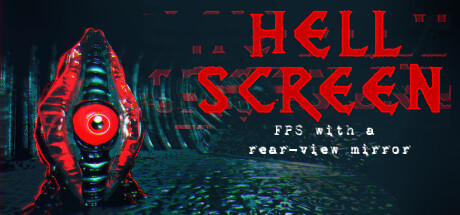
Hellscreen had one of the most genuinely creative hooks in recent FPS memory: a rearview mirror. Instead of shooting enemies ahead of you, you fought threats attacking from behind, using a mirror mounted in your field of view like a paranoid trucker in a hellscape. It was weird, it was original, and it launched into a boomer shooter market so saturated that originality alone couldn’t buy a seat at the table.
Built by solo developer Jamie D and published by tiny UK outfit Mixtape Games, Hellscreen arrived on Steam in February 2026 — roughly six years into the boomer shooter revival that DUSK and Ion Fury kicked off. By then, players had Ultrakill, Prodeus, Turbo Overkill, Amid Evil, and dozens more competing for the same retro-FPS audience. The game collected 48 reviews at an 81% positive rate, which in most genres would be a solid start. In this one, it was a whisper in a crowded room.
The pricing didn’t help. At A$26.50, Hellscreen sat 30-75% above the boomer shooter sweet spot of A$15-22 — a range established by genre titans with far more content and polish. For an unknown developer’s debut title, premium pricing is a bet that your game will sell itself on reputation. Hellscreen had no reputation to spend.
The numbers tell a merciless story. An estimated 2,000-5,000 actual owners (the SteamSpy 200K-500K figure is noise at this scale). Review velocity of 28.7 per month concentrated almost entirely in the launch window, suggesting a brief burst of curiosity followed by silence. By May 2026, concurrent players hit zero — not “a handful,” not “single digits,” but zero. The game that asked you to fight with your back turned had no one left watching.
The Metroidvania elements and horror atmosphere hinted at a developer with ambition beyond the genre’s typical run-and-gun formula. But combining two demanding design paradigms — fast-paced FPS and exploration-based progression — is brutally hard for a solo developer to pull off, and the rearview mirror mechanic that made Hellscreen memorable in concept proved divisive in practice. Positive reviewers praised its creativity; negative reviewers reported headaches and disorientation within 20 minutes.
Hellscreen is the quiet kind of game death — no controversy, no dramatic studio implosion, no angry Reddit threads. Just a creative idea that arrived too late to a party that was already winding down, priced too high for impulse buyers, and published too quietly for anyone to notice.
Key Failure Factors
-
Late to the Revival: The boomer shooter renaissance began around 2020 with DUSK, Amid Evil, and Ion Fury. By 2026, the genre had matured into a crowded market where dozens of polished titles competed for a finite audience. Hellscreen launched six years into the cycle, well past the point where genre novelty alone could drive sales.
-
A Niche Within a Niche: The rearview mirror mechanic was genuinely creative but inherently polarizing. Fighting enemies you can’t directly see narrows the appeal even within an already-niche genre. Only 48 reviews accumulated, suggesting the concept intrigued few and alienated some who tried it.
-
Overpriced for an Unknown: At A$26.50, Hellscreen cost more than genre-defining hits like DUSK (US$20) and Amid Evil (US$20) that offered significantly more content. Unknown developers cannot charge premium prices without brand recognition to back them up.
-
Invisible Publisher: Mixtape Games UK lacked the marketing muscle of genre powerhouses like New Blood Interactive. No evidence of major YouTuber coverage or a pre-launch campaign meant the game relied entirely on Steam’s algorithm for discovery — a losing bet in a saturated category.
Lessons for Developers
-
Innovation requires flawless execution in crowded markets. Hellscreen’s 81% positive reviews prove the mirror concept had merit, but 48 total reviews and 0 current players show that a clever mechanic cannot compensate for entering a mature genre late without polish and marketing muscle.
-
Price signals expectations. Charging A$26.50 when genre staples sell for A$15-22 tells potential buyers this game believes it belongs alongside the best. For a debut title from an unknown developer, that’s a promise the store page can’t deliver on — and it kills impulse purchases.
-
Timing trumps creativity in genre cycles. The boomer shooter audience had found its favorites by 2026. Late entrants need either extraordinary quality or extraordinary marketing to displace established games. Hellscreen had a unique hook but neither the production values nor the publisher reach to break through.
-
Solo developers should match ambition to resources. Combining FPS, Metroidvania, and a novel mirror mechanic is three ambitious design bets at once. Any one of them is hard to execute alone; together, they spread a solo developer’s limited resources too thin.
Related Deaths
- LawBreakers — Another game with a unique mechanical hook (zero-gravity combat) that launched into an oversaturated shooter market and couldn’t find an audience despite positive reception from those who played it.
- Forgive Me Father 2 — A late-cycle boomer shooter that struggled with the same genre saturation, proving that even sequels to moderately successful titles couldn’t guarantee traction by the mid-2020s.