CRITICAL CONDITION REPORT
Book of Travels
Might and Delight
Born
2021-10-10
Status: Declining
2024-01-07
Lifespan (2.2 years)
Advertisement
Autopsy Report
Condition Report
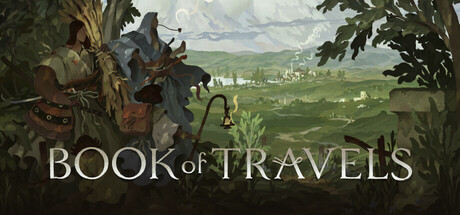
Book of Travels tried to invent a genre and ended up inventing a new way for multiplayer games to fail. Developed by Swedish indie studio Might and Delight — the team behind the atmospheric Shelter series — this self-described “TMORPG” (Tiny Multiplayer Online RPG) launched into Early Access in October 2021 with a genuinely novel pitch: wander a gorgeous watercolor world, communicate through emotes instead of text, and experience the quiet magic of stumbling upon a stranger on the road. With 100,000-200,000 estimated owners and a 75% positive review score from 2,073 reviews, the game clearly resonated with someone. The problem is that someone needed to be online at the same time as everyone else.
The numbers tell the story of a slow-motion population collapse. At 37.9 reviews per month across a 27-month lifespan, Book of Travels maintained a trickle of new players — never the flood a multiplayer game needs to sustain its core loop. The game’s fundamental design paradox is visible in its own Steam tags: “Singleplayer” sits alongside “MMORPG,” “Relaxing” next to “Action,” “Walking Simulator” beside “RPG.” When your own community can’t agree on what genre you are, word-of-mouth — the lifeblood of indie marketing — breaks down. You can’t recommend a game you can’t describe.
The pricing didn’t help. At A$43.95, Book of Travels positioned itself as a premium experience in a space where competitors thrived on lower barriers to entry. Sky: Children of the Light went free-to-play and built a massive community. Journey kept sessions short enough that matchmaking could guarantee encounters. Book of Travels charged full price for entry into a persistent world that needed population density to function — and every price barrier made that density harder to achieve.
Today, with 1 current player and 0 average playtime over the past two weeks, the TMORPG concept has hit its logical endpoint. The game isn’t delisted — you can still buy it for A$43.95 — but you’d be purchasing a ticket to an empty theater. The watercolor landscapes are still beautiful, but the core promise of meeting fellow travelers on the road has become statistically impossible. Book of Travels is a multiplayer game in which multiplayer no longer exists.
Warning Signs
-
The Population Death Spiral: With 100,000-200,000 owners but only 1 current player, Book of Travels demonstrates the most dangerous feedback loop in multiplayer game design. Each departing player makes the experience worse for those who remain, accelerating further departures. For a game whose entire value proposition was “meet strangers in a shared world,” the spiral was fatal — fewer players meant fewer encounters, which meant less reason to play, which meant fewer players.
-
Genre Identity Crisis: The game’s tag cloud reads like a contradiction engine: “Singleplayer” and “MMORPG,” “Relaxing” and “Action,” “Walking Simulator” and “RPG.” The self-coined “TMORPG” label never gained traction on Steam. When players can’t classify your game, they can’t recommend it, and Steam’s algorithm can’t surface it to the right audience. The 75% positive review score masks a likely bimodal split between enchanted explorers and frustrated loners.
-
Early Access as Multiplayer Poison: Launching a population-dependent game as explicitly unfinished meant first impressions were of a beautiful but empty and incomplete world — the worst possible introduction for a concept that needs other people to prove its value. The “Early Access” tag remained the game’s #1 Steam tag, dominating even genre descriptors and signaling to potential buyers that the experience wasn’t ready.
-
Premium Price for Population-Dependent Play: A$43.95 for an Early Access indie created a barrier that directly undermined the game’s need for player density. Competitors in the contemplative multiplayer space (Sky: Children of the Light, free-to-play) solved the population problem by removing the price barrier entirely. Book of Travels needed maximum accessibility and chose premium positioning instead.
Lessons for Developers
-
Model your minimum viable population before committing to multiplayer design. Book of Travels needed concurrent players spread across a large world to deliver its core promise. With 100,000-200,000 total owners, the math on concurrent population density never worked. Any multiplayer game should answer: “How many simultaneous players do we need, and what’s our plan to maintain that number?” If the answer depends on factors outside your control, your design has a structural risk.
-
Inventing a genre is exponentially harder than iterating on one. The TMORPG had no established audience, no comparison points, and no proven market. The contradictory tag cloud — Singleplayer, MMORPG, Walking Simulator, RPG — shows that even engaged players couldn’t classify it. Novel concepts need twice the marketing budget, not half.
-
Early Access and multiplayer are a dangerous combination. Single-player Early Access games ask players to tolerate rough edges. Multiplayer Early Access games ask players to tolerate rough edges AND an empty world, because the population hasn’t built up yet. First impressions drive population, and population drives the multiplayer experience — launching incomplete means your first users experience the worst possible version of your game.
-
Price your game to solve your biggest problem, not to reflect your production values. Book of Travels’ art direction justified premium pricing in isolation, but the game’s existential threat was population density, not revenue per user. A lower price point or free-to-play model might have traded revenue per user for the concurrent population the design desperately needed.
Similar Cases
-
Worlds Adrift — Another indie studio that invented a new multiplayer concept (physics-based persistent world) and found that novelty alone couldn’t sustain the population required for the experience to work. Shut down in 2019 after failing to reach critical mass.
-
Gigantic — A multiplayer game with breathtaking art direction that proved beautiful visuals couldn’t compensate for insufficient player population. The matchmaking queues grew longer as players left, accelerating the death spiral.
-
WildStar — An MMO that deliberately targeted a niche audience (hardcore raiders) and discovered the niche was too small to sustain the game’s operational costs, mirroring Book of Travels’ bet on an untested micro-genre.